If you own a large or giant breed dog and you have ever come home to a puddle spreading past the edge of a “big” pee pad, you already know the truth most pet brands will not say out loud. The problem usually is not your dog. It is the pad.
Most pads on the shelf were designed for a 10-pound puppy. When a 150-pound dog uses one, the math simply does not work. This guide walks through how to size a pad correctly for a big dog, what the marketing terms actually mean, and, just as important, when you should skip the oversized gear and buy the cheap stuff instead. We would rather give you the right answer than sell you something you do not need.
A pad problem, not a dog problem
Puppy pad, pee pad, potty pad, training pad: all the same product. The word "puppy" is just marketing, and it is the reason so many big-dog owners buy the wrong thing.
A dog’s age has nothing to do with whether he needs a pad. Adult dogs, senior dogs, dogs recovering from surgery, and dogs with incontinence are some of the most frequent users. The pad is a tool, not a stage of life.
So if you are shopping for a full-grown Mastiff, do not let the cartoon puppy on the box talk you out of it. The real question is never the dog’s age. It is whether the pad is built for the dog’s size.
The geometry of a big dog
For a pad to actually work, your dog needs to fit his whole body over the absorbent part while he goes. That sounds obvious, but it is where standard pads fall apart.
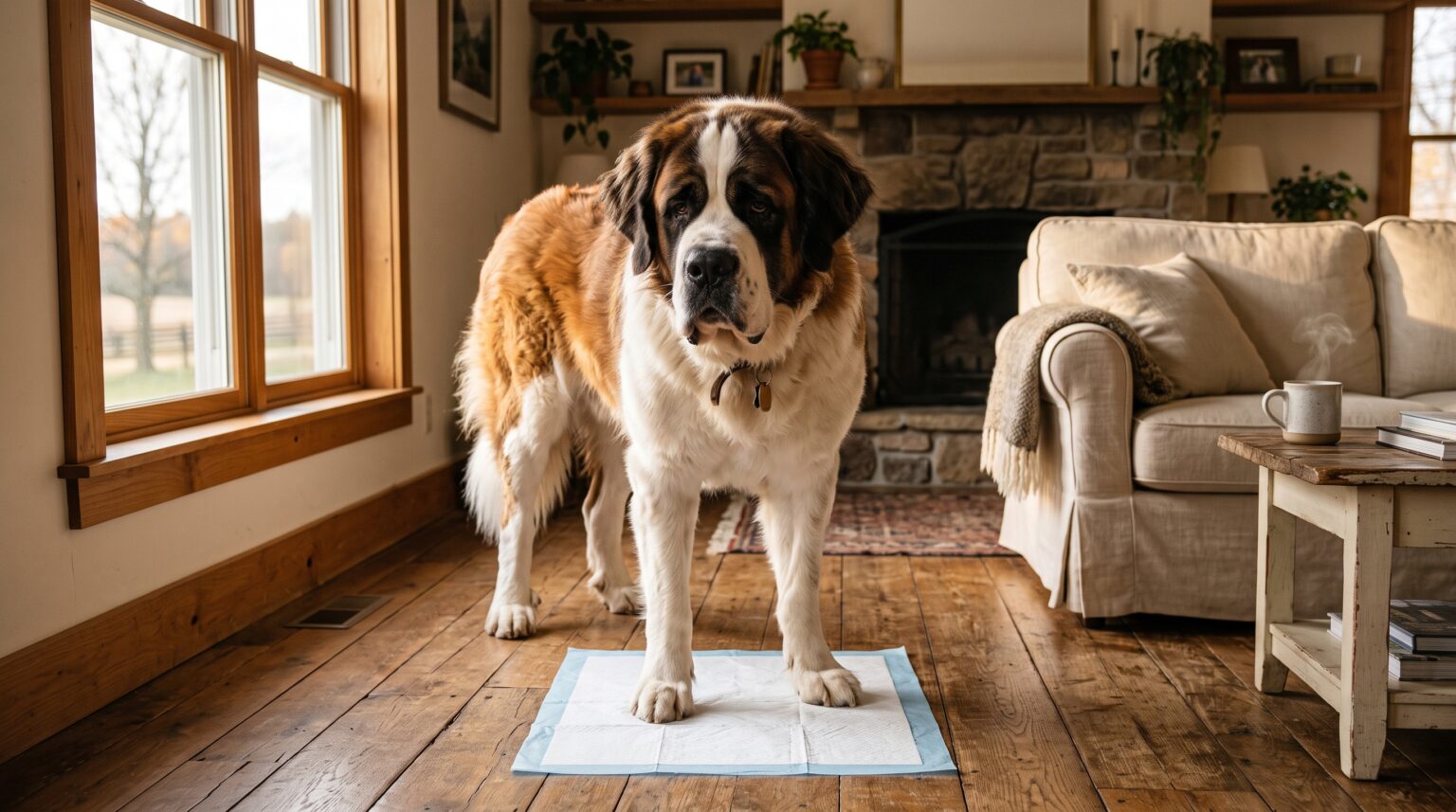
A dog does not stand neat and still when he eliminates. A male lifting a leg or a female dropping into a wide squat needs a lot more floor than their standing footprint suggests. Picture a Great Dane, a breed that stands 30 to 32 inches at the shoulder. Nose to tail, he often stretches past 40 inches. Set him on a pad with a usable area under 30 inches long and the back half of the dog is hanging off the edge before he even starts. The pad’s absorbency rating does not matter at that point, because the urine is landing on your floor, not on the pad.
The “usable core” problem nobody talks about
Stated size versus the part that actually absorbs
Here is the detail that costs big dog owners the most grief. The size printed in big letters on the front of the box is the total pad, including the plastic leak-proof border around the edge. That border does not absorb anything. The part that does the work, the usable core, is smaller, and sometimes it is a lot smaller.
Take a common 22 by 22 inch standard pad. Strip off the roughly one and a half inch plastic border on each side and you are left with an absorbent core closer to 19 by 19 inches. That is about a quarter of the pad gone before your dog does a thing. The same pattern holds on many pads sold as “XL.” The number on the box looks big. The core you actually get is noticeably smaller.
Why the border causes runoff
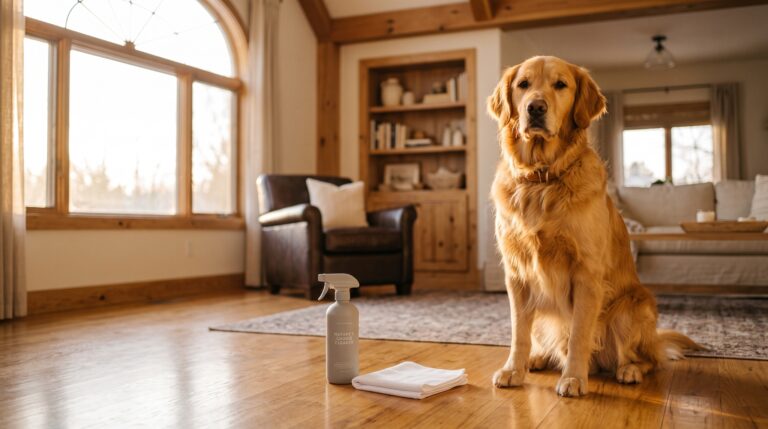
That plastic edge is not just wasted space, it is a liability. When a big dog releases a fast, heavy stream near the border, the liquid hits plastic instead of absorbent core and runs straight off onto the floor. On hardwood, that is exactly the kind of repeated soaking that warps boards and lifts finish over time. (Already dealing with the aftermath? Here is how to get dog pee smell out of hardwood and carpet, for good.)
So when you compare pads, compare the usable core, not the headline number. For the record, our own pads are stated at XL 30 by 36 inches, XXL 36 by 36 inches, and XXXL 37 by 54 inches, and a bigger overall footprint is what gives you a bigger core to work with.
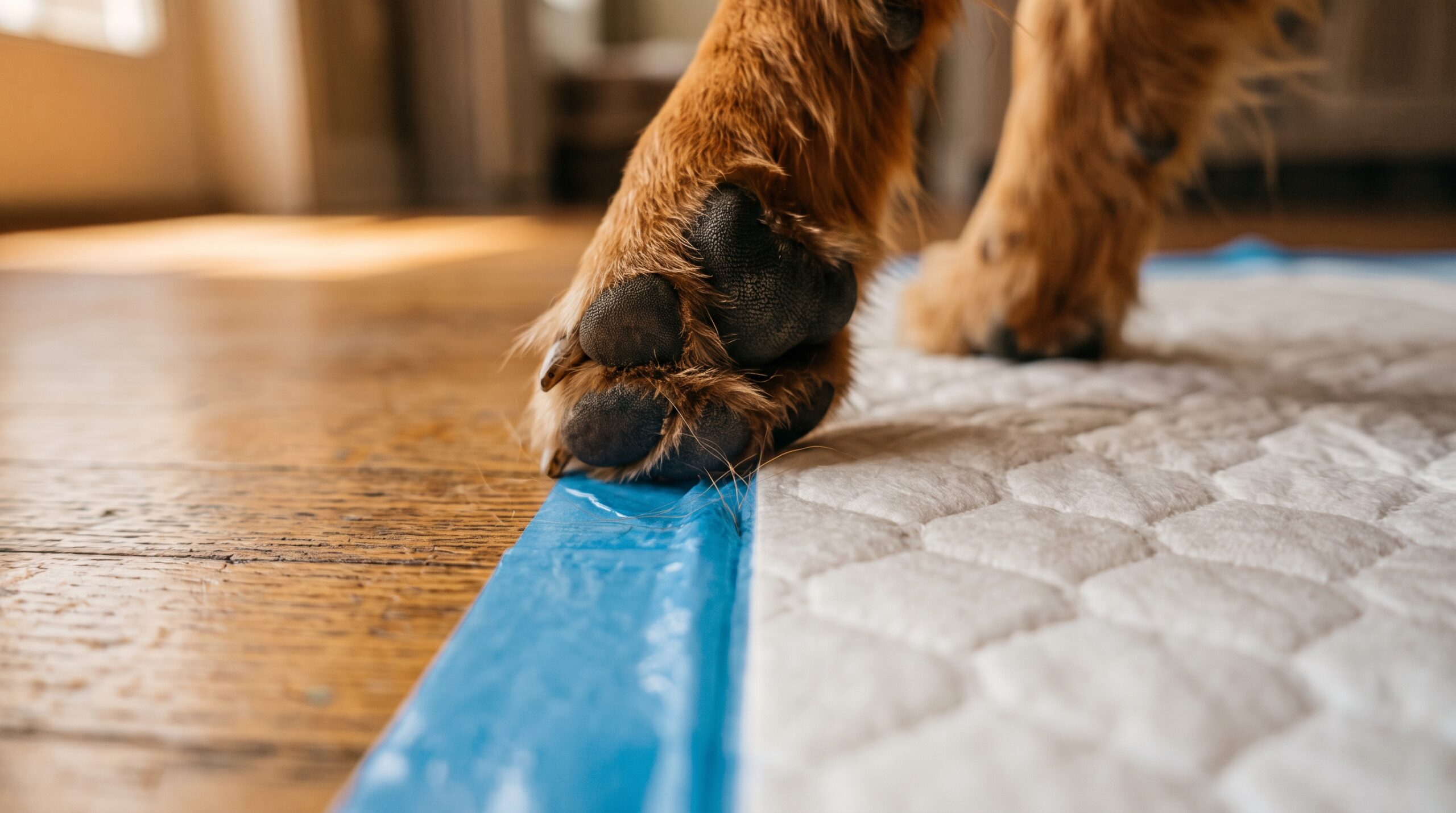
A bigger footprint is a bigger core
Strip the plastic border off a standard 22 by 22 inch pad and you are left with about 360 square inches that actually absorb. Our XXXL is 37 by 54 inches, nearly 2,000 square inches of pad, and the bigger the overall footprint, the bigger the working core. That is the whole difference between a pad that holds a big dog’s puddle and one that lets it run onto your floor.
The science of absorbency: matching bladder to pad
It is the polymer, not the paper
“Super absorbent” is a marketing phrase, not a measurement. What actually determines how much a pad can hold is the superabsorbent polymer, or SAP, in its core. SAP is a fine powder (sodium polyacrylate) that reacts with liquid on contact, swelling into a gel and locking the moisture in place so it cannot slosh back out.
A pad that leans mostly on paper pulp and tissue layers instead of a real dose of SAP will do fine for a small dog. Hit it with a heavy stream from a 150-pound dog and the paper cannot drink fast enough. The liquid puddles on the surface and escapes off the sides before it can soak in. This is why the layer count on the box tells you very little. The volume of quality SAP is what counts.
For what it is worth, we publish our real numbers instead of hiding behind adjectives. Our XL holds over 6 US cups before it fails, the XXL holds over 7, and the XXXL holds over 8. Those are lab-measured capacities, not guesses.
How much does a big dog actually produce
This is the part that settles the argument. A healthy large or giant breed dog produces more than a quart of urine across a day, and a good share of that comes out in just a few squats. A single full void from a big dog is not a few tablespoons. It is often a cup or more, and from a giant breed it can be two to three cups, released in seconds.
Compare that to a pad built for a small dog, which might be rated to hold six or eight ounces total. It tops out, the excess pools, and you are cleaning the floor. Even a routine morning empty from a large dog is far more than a toy-breed pad was ever meant to absorb. A pad sized and built for the volume simply holds it.
"A big dog does not need a bigger promise on the box. It needs a bigger core on the floor."
When indoor pads make sense for a big dog
Pads are not just for untrained puppies, and there is no shame in using them. There are real, sometimes medical, reasons a big dog needs a dependable indoor spot.
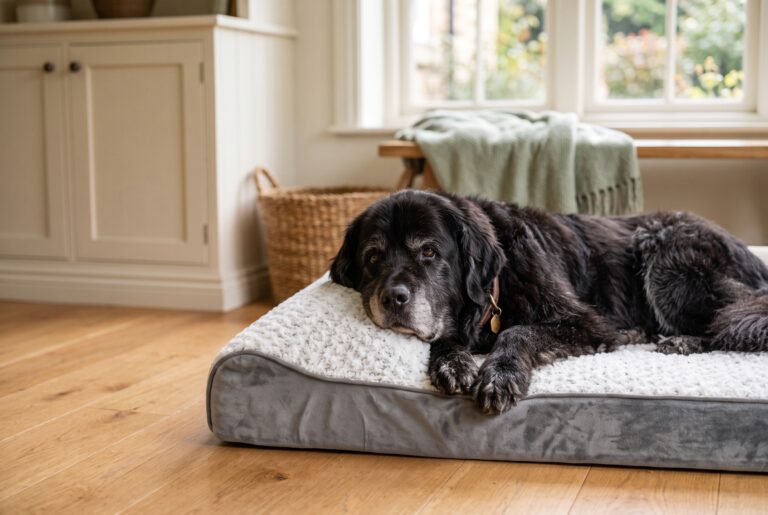
Senior dogs. As large dogs age, many develop weakened bladder control and start leaking, especially overnight. Others develop canine cognitive dysfunction, a dementia-like decline that can erode old house-training habits. Add arthritis that makes stairs painful, and a nearby pad is simple kindness.
Recovery from surgery. After a major orthopedic procedure like a TPLO, a big dog is often on strict crate rest and cannot safely walk outside. A high-capacity pad handles relief with zero mobility required.
Apartment and high-rise living. When the trip to the street runs through a hallway, an elevator, and a lobby, the clock can beat a full bladder. An indoor backup prevents the accident on the way down. (It also helps to know how dogs tell you they need to go.)
Northern winters. Here in Wisconsin we do not have to explain this one. Sub-zero cold, deep drifts, and hidden ice are hard on paws and hard on footing, for the dog and for you. A reliable indoor option on the worst nights is a safety feature.
Whelping. Breeders need large, seriously absorbent surfaces during and after a litter. This is not a small-pad job.
If any of these fit your dog, a big pad is not a crutch. It is the right tool.
How to compare pee pad costs honestly
A 100-count box for around twenty dollars looks like a deal, and for a small dog it is. For a big dog it is a trap.
If you try to cover enough floor for a Great Dane with standard pads, you end up overlapping four of them. All four get soaked and thrown out after one use, and urine tends to leak right through the overlapping seams onto the floor underneath. So your real cost is four pads per event, plus cleanup, plus the wear on your floors. Measured by cost per actual use, one properly sized pad usually wins, and it does not leak at the seams because there are no seams.
The honest exception: small dogs should buy cheap
We will say this plainly, because it is true. If you have a Chihuahua, a toy Poodle, or any dog under 10 pounds, do not spend extra on giant-breed gear. A basic budget pad from any big-box store is plenty for a small bladder. Our oversized pads are built for large-volume dogs where standard pads physically cannot keep up. If that is not your dog, save your money.
Common big dog pad mistakes
Taping two pads together. It feels resourceful, but liquid follows the path of least resistance. A big dog’s stream hits the seam, works between the two plastic borders, soaks the tape, and pools on the floor. You need one continuous absorbent core to stop runoff.
Trusting the words “super absorbent.” Absorbency claims in the pet aisle come with no standard test behind them. “Super absorbent” on a small-dog pad might mean it holds six ounces. A big dog can need several cups, not several ounces. Look for a stated cup or ounce capacity, not adjectives.
Worrying that pads ruin house-training. This one is more contested than the internet suggests. Dogs do form substrate preferences, meaning they get used to going on a particular kind of surface, so offer a soft pad indoors and some dogs will favor soft surfaces. But dogs can be transitioned from pads to grass, or taught to use both on cue, and the major training organizations back that up. And for apartment dwellers or owners of incontinent seniors, the indoor pad is the permanent goal anyway, so there is nothing to “ruin.”
How our three sizes map to dogs
- XL, 30 by 36 inches
- Large breeds up to about the size of a Golden Retriever.
- XXL, 36 by 36 inches
- Broad, heavy dogs like a Bernese Mountain Dog.
- XXXL, 37 by 54 inches
- The giant-breed pad, sized for a Saint Bernard, Great Dane, or Mastiff.
Sizing up for success
The short version: ignore the headline number and the cartoon puppy, look at the usable core and the real cup capacity, and match the pad to what your dog actually produces. Big dogs make big messes, and a pad built for a small one will keep failing no matter how many you stack up.
If you want help landing on the right one, our Find Your Pad calculator and size guide will point you to the XL, XXL, or XXXL based on your dog. If you are starting from zero with a new dog, our complete guide to big-dog potty training covers the whole journey. And if you have a small dog, we just told you to buy the cheap ones. That is the kind of straight answer we would want, so it is the kind we give.
This article is for general information and is not medical advice. If your dog is leaking, straining, or drinking or urinating more than usual, talk with your veterinarian, since a sudden change in bathroom habits can signal a health issue.