Pee pads have a reputation problem. Plenty of trainers will tell you to skip them entirely, and for some dogs on some days that is fair advice. But if you have a puppy who is not done with his shots, a senior who cannot make it through the night, an apartment ten floors up, or a Wisconsin January between you and the yard, a pad is not a shortcut. It is the right tool.
The honest truth is that pee pad training a big dog is not harder than training a small one. The method is identical. What changes is the gear. A ninety-pound dog brings two problems a Chihuahua never will: the pad slides out from under him, and he misses the edge. Solve those two things and the rest is just patience and a schedule.
Here is how we do it, the same way we would tell a neighbor over the fence. What actually works, what wastes your time, and when the problem is not training at all but a reason to call your vet.
New here? This article is part of our complete guide to big-dog potty training.
Can you really pee pad train a big dog?
Yes. The size of the dog does not change whether pads work. It changes the size of the pad you need.
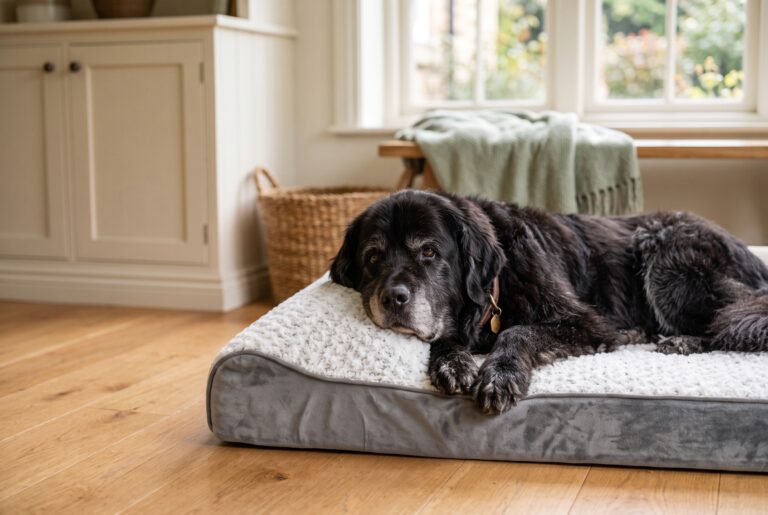
Pads earn their keep for a few specific dogs: puppies who are not yet protected from parvo, seniors dealing with incontinence or arthritis, dogs recovering from surgery, and anyone whose only bathroom is down an elevator. For those situations a pad is genuinely the kind thing to do.
But it is not only the hard cases. Sometimes a pad is simply about comfort, your dog’s and yours. You are gone for a full workday and the afternoon runs long. You are a heavy sleeper and your dog wakes at two in the morning needing to go. In a house without a pad, that ends with a frantic dog and a puddle by the front door, through no fault of his own. With one in his spot, he handles it himself and everybody keeps their dignity. That is not laziness. It is giving a dog a reasonable option for the hours you cannot be standing at the back door.
There is one trade-off worth saying out loud. Dogs form strong habits about where they go, and the more a dog learns that going indoors is allowed, the longer fully outdoor training can take later. Humane World for Animals (formerly the Humane Society) makes the same point. That is not a reason to avoid pads. It is a reason to be deliberate: decide what you want long term, and train toward it from day one.
Start with the right size pad
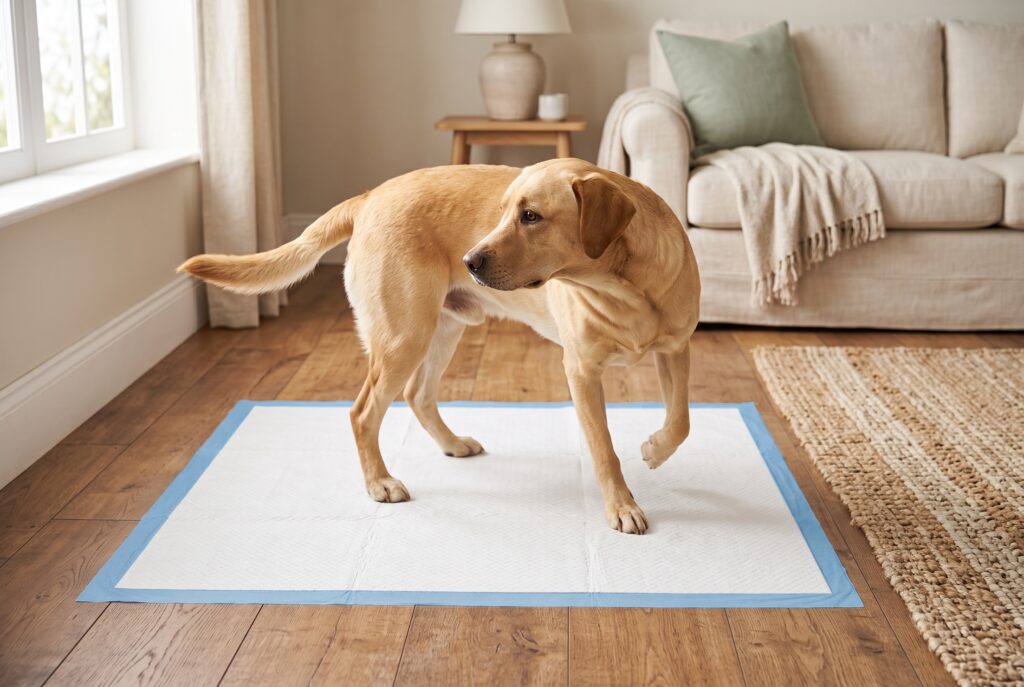
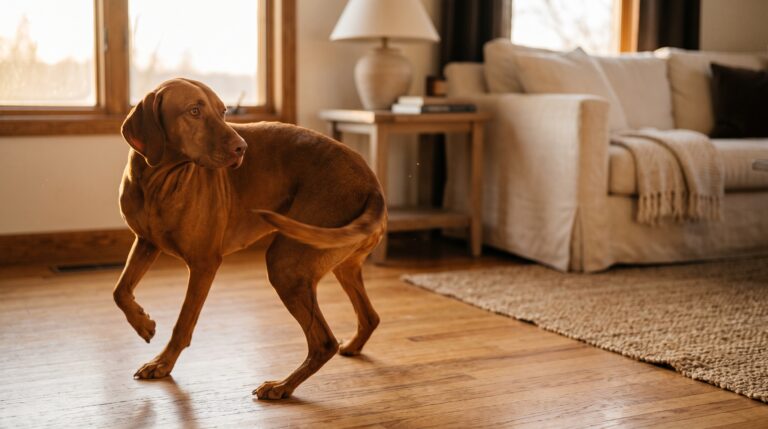
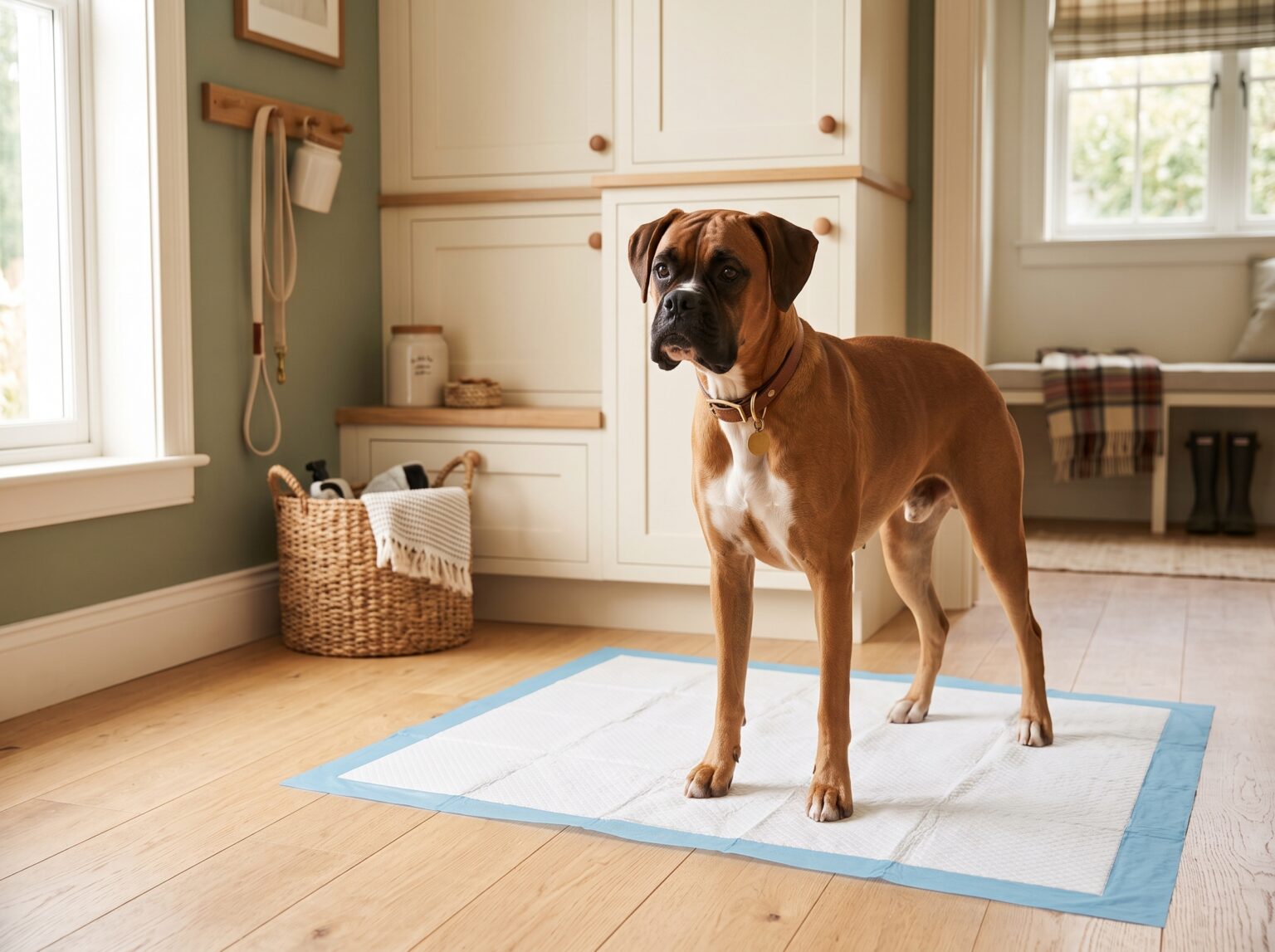
This is the step most big-dog owners get wrong, and it is the reason so many give up. A dog does not miss the pad because he is untrained. He misses because the pad is too small for the way he moves. Dogs circle before they go, and a big dog circling needs room for his back legs to swing around without stepping off the edge. (We wrote a whole piece on why dogs spin before they go if you want the science.)
Here is our honest sizing, including the size we do not even make:
- Under about 30 lb (small and toy breeds): a standard 22 by 22 pad is genuinely all you need. We do not make one that small, and you should not overpay for one. Buy any quality pad and move on.
- About 30 to 75 lb (Golden Retrievers, Labradors, Australian Shepherds): the XL Farmhouse Pee Pad, 30 by 36, is the large-breed baseline.
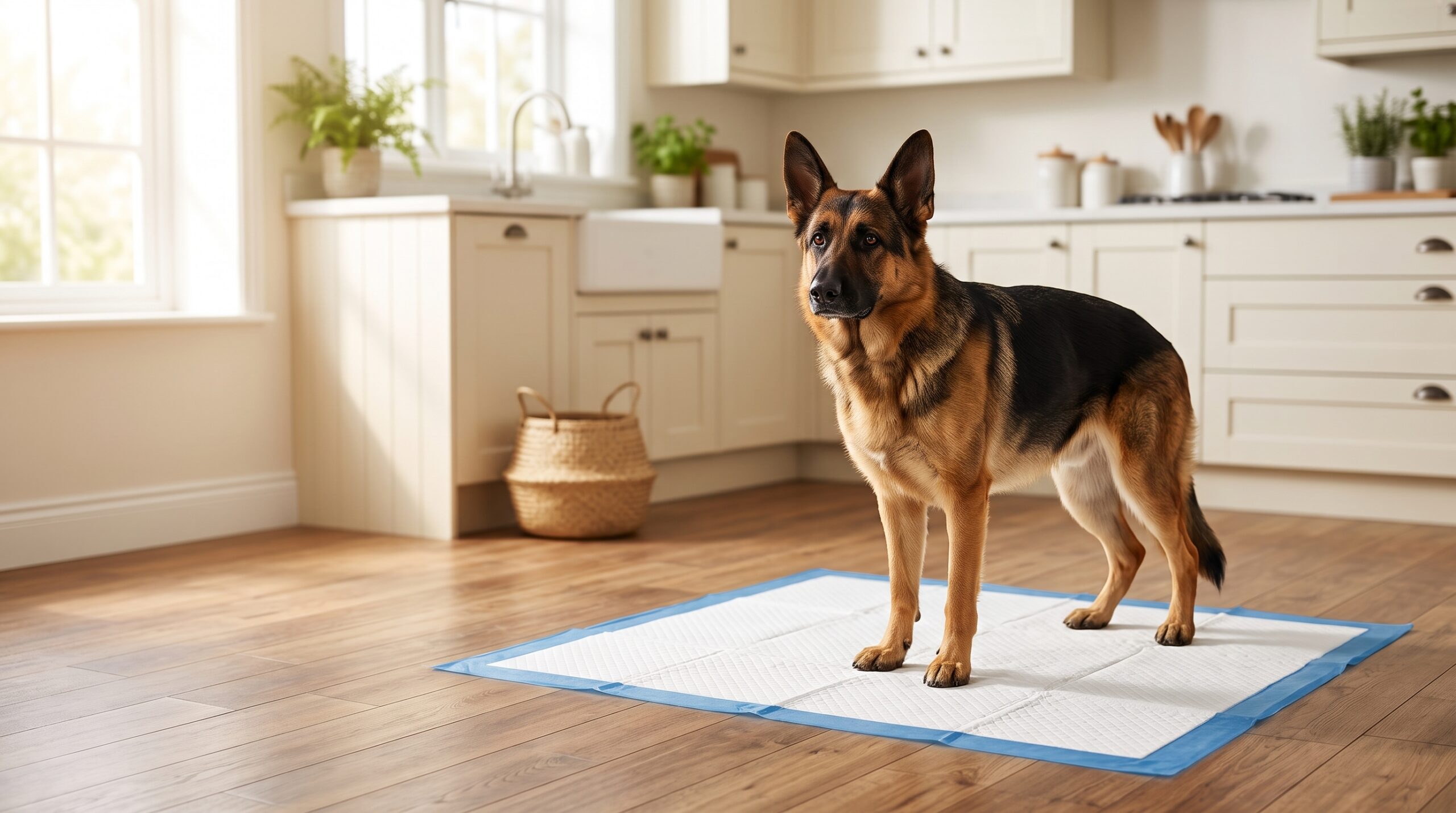
- About 70 to 115 lb (German Shepherds, Boxers, Bernese Mountain Dogs): the XXL, a full 36 by 36 square, gives equal turning room in every direction.
- About 120 lb and up (Saint Bernards, Mastiffs, Great Danes): the XXXL, 37 by 54, is the size the big-box brands forgot.
When your dog falls between two sizes, go up. A pad that is a little too big costs you nothing. A pad that is too small costs you the whole point of buying one: you end up with urine on the floor, money wasted, you frustrated, and the dog frustrated right along with you.
An undersized pad fails in two ways. First, the dog cannot place himself on it, his back legs swing off mid-turn and he simply cannot aim onto a target that small. Second, even a careful dog who learns to plant himself dead center to keep you happy will still overrun a pad that was never built for his volume. A 22 by 22 square was never designed for a dog producing five, eight, or more cups of urine in a day. The dog does everything right and it leaks anyway. Not sure where your dog lands? Find your pad in about ten seconds.
The method, step by step
Strip away the marketing and house-training is four moves: confine, schedule, cue, and reward. Never punish. That is the whole game, and it works the same for a Mastiff as a Maltese.
1. Confine, then expand
A dog will not soil where he sleeps if he can help it. Start small: a crate sized so he can stand up and turn around but not roam, or a small gated area with the pad in it. As he earns reliability, you give him more room. Confinement is not punishment. It is how you prevent the unsupervised accidents that teach bad habits in the first place.
2. Build the schedule around his bladder
Take your dog to the pad first thing in the morning, after every meal, after naps, after play, and right before bed. Puppies need it far more often than you would guess. A rough rule from Humane World: a puppy can hold his bladder about one hour for every month of age while awake, so a three-month-old needs a trip roughly every three hours. The American Kennel Club frames the overnight version a little differently, the dog’s age in months plus one. The two rules disagree by about an hour, which is your cue to treat both as guidelines, not gospel. The table below puts it together.
3. Cue, then pay immediately
Pick a short phrase, something like “go potty,” and say it as he goes, not after. The instant he finishes on the pad, reward him: a treat and warm praise within a second or two, while he is still standing on it. Dogs live in the moment. A reward thirty seconds later, back in the kitchen, teaches him that walking to the kitchen is what earned the treat.
4. Handle accidents without drama
Accidents are information, not defiance. If you catch him mid-stream, calmly interrupt and guide him to the pad. If you find it after the fact, clean it and say nothing. Use an enzymatic cleaner, not soap or vinegar, because dog urine leaves behind uric-acid salts that ordinary cleaners do not break down. Miss those and the spot still smells like a bathroom to your dog, which is an open invitation to use it again.
How long can your dog hold it?
- 8 weeks old
- About 2 hours. Expect a trip the moment he wakes, eats, or finishes playing.
- 3 months
- Roughly 3 to 4 hours while awake. (Humane World says about 3; the AKC age-plus-one rule says up to 4.)
- 4 to 5 months
- Around 4 to 5 hours. Still set a timer; do not wait for him to ask.
- 6 months
- About 6 hours, closing in on adult capacity.
- Healthy adult
- VCA puts it at 3 to 4 hours if inactive. Six to eight is a practical ceiling, not a daily goal.
- The hard limit
- No dog of any age should be made to hold it longer than 6 to 8 hours. That is a welfare line, not a target.
A big dog makes a big puddle
A healthy hundred-pound-plus dog produces roughly 4 to 8 cups of urine a day. (Markedly more than that is worth a vet visit; it can signal a condition called polyuria.) All of it has to land on the pad, and it lands in one go, not in tidy installments. An undersized pad does not contain a big dog’s output, it just relocates the overflow to your floor. This, more than any clever training trick, is why the right size matters.
"A big dog on a small pad is not a training failure. It is a sizing failure, and that one is on us, not the dog."
Size is half the battle. Absorbency is the other half.
Here is where most pad advice goes quiet, and where we refuse to. Get the size right and you have solved where your dog goes. You still have not solved whether the pad can hold it. A pad that fits your dog perfectly and soaks straight through is just a slower mess on the same floor.
The thing that actually traps the liquid is the super-absorbent polymer, the SAP, the gel core layered inside the pad. It is also the one number almost nobody will print. Pull up a bargain pad listing and you will find a wall of marketing words and not a single figure for how much SAP is inside. There is a reason for the silence. In our own testing, common 30 by 36 and 36 by 36 pads carried as little as 4 to 9 grams of SAP, nowhere near enough for a dog that empties a liter or two in one go. A pad built that thin is a glorified napkin. It tears, it leaks at the seams, and it wicks right back onto your floor the moment your dog stands on it.
We built Farmhouse the other way around. Our biggest pad, the 37 by 54, is engineered with 19 grams of premium Japanese SAP, more than any pad we have been able to find anywhere, and that number is not for show. We tested our way to it, because a giant-breed dog needs that much to lock the liquid down and keep it there. The cheap imports stacked on most big-box shelves are built to a price, not to your dog.
So when you shop, ask the one question the bargain brands hope you skip: how much SAP is in this pad? If they cannot tell you, you already have your answer.
Stop the pad from sliding
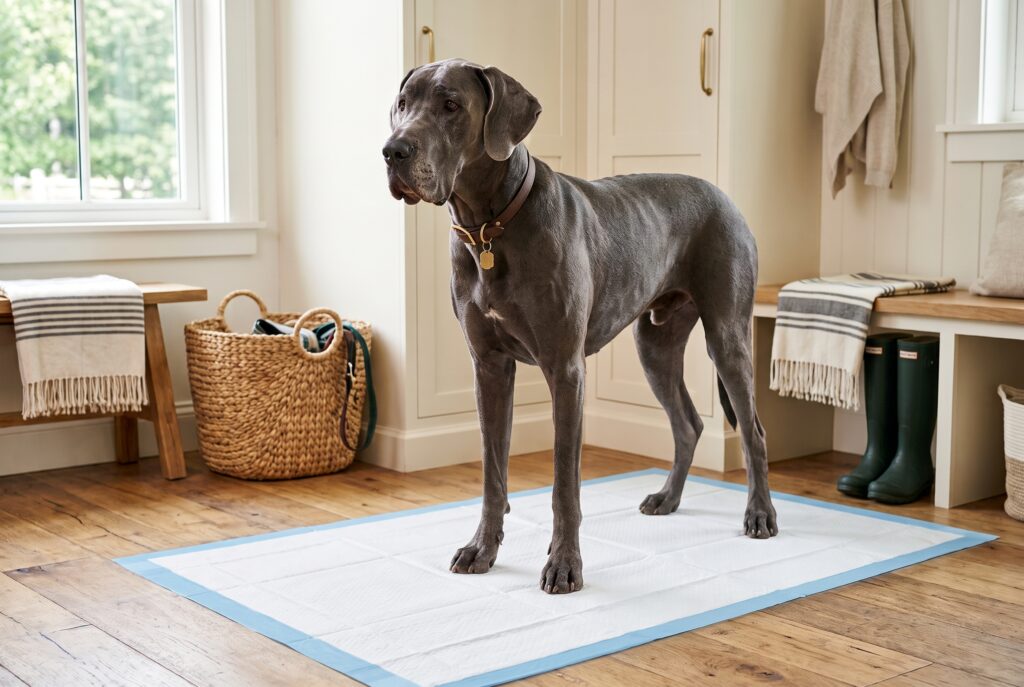
A small dog steps onto a pad. A big dog launches onto it, pivots his full weight, and sends it skating across the tile, leaving him standing on bare floor with a crumpled pad behind him. This is a gear problem, and gear solves it.
- Start with adhesive tabs. This is the simplest fix, and it is the one we feel strongest about. Sticky tabs hold the pad’s corners flat to a hard floor so it cannot skate, and they give a leg-lifter a fixed edge to square up to. Here is what bothers us about the rest of the aisle: most pads do not come with tabs at all, and the brands that do offer them treat it as a paid add-on. We think that is backwards. You need them, so we include a set with every Farmhouse pad, every size, no upcharge. Use them or don’t, but you should never have to pay extra to keep your pad flat on the floor where it belongs.
- A tray is optional, not required. Some owners like a framed holder, and it works fine. But most of our customers tell us they never bother, because a pad that genuinely absorbs does not wander the way a soaked, sagging one does. (Saturation is half of why a cheap pad slides and bunches in the first place.) If you want the structure, use a tray. Just know it is a preference, not a fix you have to buy.
- Demand real backing. A heavier pad with a grippy, leak-proof bottom layer stays put far better than a flimsy one. Thin bargain pads are light, and light is exactly what you do not want under a ninety-pound dog mid-pivot.
- Put it in a corner. Two walls will not stop a determined dog, but they limit how far the pad can travel and give him a natural place to square up.
Stop the missing and the edge-peeing
First, give your dog the benefit of the doubt. Finding urine on the floor does not automatically mean he missed. Plenty of the time he hit the pad dead-on and a cheap pad let him down: with too little SAP and thin, low-grade pulp, the urine lands and runs straight off the edge before the pad can grab it. Your dog did exactly what you trained him to do. He simply is not getting the credit, because the pad could not hold what he gave it. That does not happen with a Farmhouse pad, and it is one more reason the SAP number matters: enough of it locks the liquid in place the instant it lands, instead of letting it sheet off onto your floor.
If the pad is genuinely staying put and absorbing the way it should, and you are still finding a puddle half-on and half-off, you are looking at one of three things.
The pad is too small
By far the most common cause. Go back to the sizing section and then size up. A dog needs to turn a complete circle without a paw leaving the pad. If you cannot picture him doing that, the pad is too small. Full stop.
He is a leg-lifter
Intact and many neutered males lift, which sends urine out sideways and clean over the edge. The fix here is vertical, not horizontal: a tray with a raised wall, a pad mounted against a wall protector, or a dedicated indoor marking post. A bigger flat pad alone will never catch a sideways stream.
He is aiming for the seam
Some dogs target the line where pad meets floor, because that is where the last accident soaked in. This is almost always an odor problem. Clean every past spot with an enzymatic cleaner so there is no scent flag drawing him back to the rim.
Moving the pad to a better spot
Once your dog is reliable, you may want the pad somewhere different, tucked into a corner, off the main walkway, closer to the door he watches. You can absolutely move it. Just go slow: a few inches a day, no more. Shift it across the room overnight and you will spend the next week cleaning up the gap you skipped. Slide it gradually and your dog follows the spot without ever realizing it moved.
And let us say the quiet part plainly, because most pad advice will not: for a lot of households, the pad is not a phase to grow out of. It is the answer. A senior dog who cannot hold it overnight, a working family gone ten hours a day, an apartment ten floors up, a brutal Wisconsin January, these are not problems to train away. The pad is the destination, and there is nothing second-rate about that. Plenty of our customers have a happy, well-trained dog who has used a pad his whole life. That is a win, not a crutch.
If your goal is the yard, the method is the same in reverse: walk the pad toward the door over a week or two, then just outside it, then retire it. For a stubborn dog, the AKC suggests a scent-transfer trick, a lightly soiled pad placed outdoors tells his nose this is the spot. Want to watch it done? McCann Dogs has a clear, force-free walkthrough, and Kikopup’s housetraining videos are excellent on reward timing.
Big-dog pad training: myths worth busting
- “Dogs pee inside out of spite.”
- No. Dogs do not do revenge, and the guilty look is appeasement, not guilt. A previously reliable dog having accidents is telling you something, often a medical something. Rule that out first.
- “Rub his nose in it.”
- Never. He cannot connect a scolding to something he did minutes ago. All it teaches is to fear you and to hide the next one. The ASPCA, VCA, and AKC all agree.
- “Pads ruin outdoor training for good.”
- Overstated. They can slow it, because dogs build surface habits, but for a pre-vaccination puppy or a senior they are the right call. Transition gradually and you are fine.
- “Any pad works if the dog is trained.”
- No. A big dog on a small pad is not untrained. The pad is simply too small for his turning radius.
- “Phase the pad out whenever.”
- Move it a few inches a day once he is reliable. Big jumps cause accidents and set you back to the start.
When it is a vet visit, not a training problem
If a dog who was reliable suddenly starts having accidents, or you find damp spots where he sleeps, put down the clicker and pick up the phone. Sudden indoor accidents in an adult or senior dog can point to a urinary tract infection, bladder stones, diabetes, kidney disease, Cushing’s, incontinence, or, in older dogs, cognitive decline. VCA lists every one of these. No amount of pad work fixes a medical cause.
One more reason pads matter, this one for puppies: a pup is not fully protected against parvovirus until his vaccine series is complete, which the AVMA puts at sixteen weeks of age or older, plus a week or two for immunity to finish building. Until then, an indoor pad keeps him off contaminated ground. That is not coddling. It is basic disease prevention.
This article is general information, not veterinary advice. If your dog’s bathroom habits change suddenly, please see your veterinarian.
The honest bottom line
Pee pad training a big dog comes down to a handful of things, and none of them are tricks. Get the size right so he can turn around without stepping off. Build a schedule around his bladder, not your convenience. Cue him, then pay him the instant he finishes. Never punish a mistake. Anchor the pad so it cannot slide. And if he is still missing, go up a size before you blame the dog.
Do that and an eight-week-old puppy, a recovering adult, or a fifteen-year-old who just needs a little help will all do exactly what you are asking. They were never being stubborn. They just needed the setup to make sense.
Not sure what size your dog needs? That is the place to start. Find your pad, or see the XL, XXL, and XXXL Farmhouse pads built for big and giant dogs. And if you want to talk it through with other big-dog people, r/puppy101 and r/Dogtraining are practical, force-free, and friendly.