Potty training a big dog is not harder than training a small one. The method is the same. What changes is everything around it: the dog has a wider turn, a bigger bladder, a heavier paw that sends pads skating, and an accident that is a flood instead of a spot. Get those big-dog details right and the rest is patience and a schedule.
This is the guide we wish the pet aisle handed out. It pulls together everything we have written about getting a big or giant dog reliably potty trained, from picking the right pad to reading the signals to handling the senior years. Start here for the overview, then follow the links into the detailed guide for each step.
The whole picture, in five steps
Big-dog potty training comes down to five things: the right size pad, a simple method, reading your dog, cleaning up properly, and planning for old age. Here is how they fit together.
Most people who struggle with a big dog are not failing at training, they are missing one of these pieces. The pad is too small, or the schedule is built around the owner instead of the dog’s bladder, or a quiet signal keeps slipping past. Work through the five steps below in order and the puddles mostly disappear.
Each section is a short overview. When you want the full detail, the link at the end of each one takes you to the complete guide for that step.
Step 1: Get the pad size right
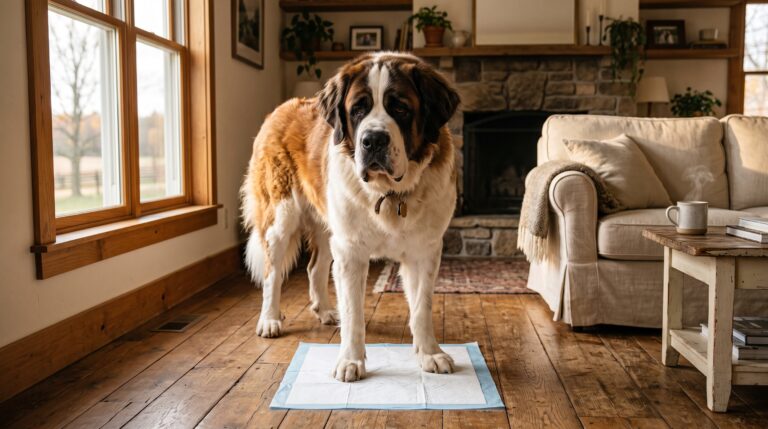
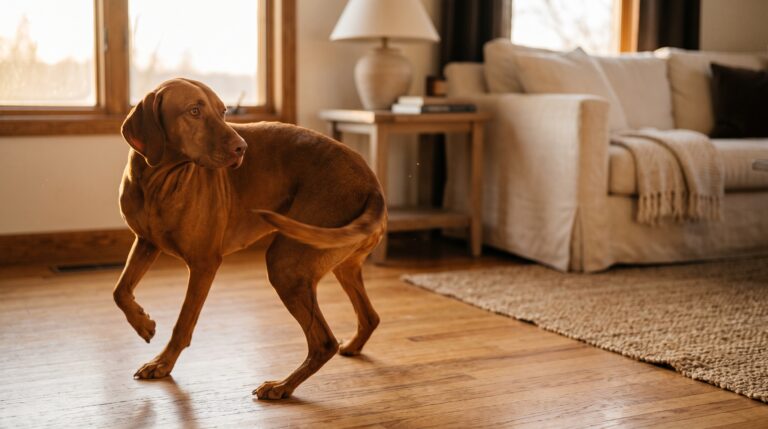
This is the step most big-dog owners get wrong, and the reason so many give up. A dog circles before going, and a big dog circling needs room for the back legs to swing around without stepping off the edge. On an undersized pad, half the dog hangs over the side and the floor takes the overflow. It is not bad aim or a training failure, the pad is simply too small for the way the dog moves.
The honest rule: when your dog falls between two sizes, go up. A pad slightly too big costs you nothing, one slightly too small ends up on your floor. Not sure where your dog lands? Find your dog’s size in about ten seconds, or read the science behind the spin and the sizing in why dogs spin before they go.
Quick pad-size reference
- Under about 30 lb
- A standard 22 by 22 pad is genuinely all you need. We do not make one this small, so buy any quality pad and do not overpay.
- About 30 to 75 lb
- XL Farmhouse Pee Pad, 30 by 36. The large-breed baseline (Golden, Lab, Aussie).
- About 70 to 115 lb
- XXL Farmhouse Pee Pad, 36 by 36. Equal turning room in every direction (Shepherd, Boxer, Bernese).
- About 120 lb and up
- XXXL Farmhouse Pee Pad, 37 by 54. The size the big-box brands forgot (Saint Bernard, Mastiff, Great Dane).
- Between two sizes?
- Go up. A pad a little too big costs nothing; one a little too small ends up on your floor.
Step 2: Follow the method
Strip away the marketing and house-training is four moves: confine, schedule, cue, and reward. Never punish. Start your dog in a small, defined space so accidents cannot happen unsupervised, build the day around regular trips to the pad, say a short cue as your dog goes, and reward the instant they finish. That is the whole game, and it works the same for a Mastiff as a Maltese.
The big-dog wrinkles are the pad sliding and the dog missing the edge, and both are gear problems with gear fixes (adhesive tabs, a real backing, the right size). We walk through the full method, the bladder-by-age schedule, and the slide-and-miss fixes in how to train a big dog to use a pee pad.
Step 3: Learn your dog’s signals
Almost every accident has a moment of warning before it: a sniff, a circle, a sudden pace toward the door, a stop in the middle of play. Big dogs in particular can be quick and quiet about it, which is how the tell slips past a busy household. Learn your dog’s personal routine and you can beat the accident to the door, and you can teach a deliberate signal, like a bell at the door, that you will catch from the next room.
The full breakdown of the natural signals, how to teach a bell or no-bell ask, and when a signal is really a health flag is in how dogs tell you they need to go.
Step 4: Clean up accidents the right way
Accidents happen, and how you clean them decides whether they happen again. Dog urine leaves behind uric-acid salts that ordinary soap, vinegar, and bleach do not break down. Miss those and the spot still smells like a bathroom to your dog, which is an open invitation to use it again. An enzymatic cleaner is the only thing that fully removes the scent marker.
For the step-by-step on carpet and hardwood, the black-stain fix, and the myths to skip (steam, vinegar, and the rest), see how to get dog pee smell out of carpet and hardwood.
Step 5: Plan for the senior years
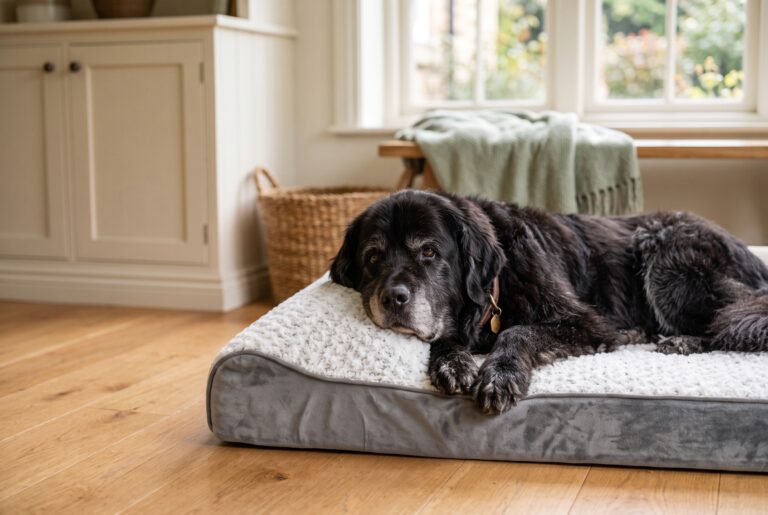
Big dogs age sooner, and an old dog who starts leaking or having accidents is almost never misbehaving. It is usually a medical change, and most of the time it is one a vet can treat. The key is telling true incontinence (involuntary leaking during sleep) from house-soiling (a loss of training, often cognitive), because the fixes are different. At home, a properly sized overnight pad, a waterproof orthopedic bed, and a late last-call trip keep a senior clean and comfortable.
The full guide to causes, treatment, and overnight care is in senior dogs and nighttime accidents.
When to call the vet
Training fixes training problems, not medical ones. If a previously reliable dog suddenly starts having accidents, drinks far more than usual, strains to urinate, or has blood in the urine, treat it as a health question first and call your veterinarian. No amount of pad work fixes a urinary tract infection, diabetes, or kidney trouble.
This guide is general information, not veterinary advice. For any sudden change in your dog’s bathroom habits, please see your veterinarian.
The honest bottom line
Get the size right, follow the simple method, learn your dog’s signals, clean up properly, and plan for the senior years. That is the entire job, and none of it requires a trick. Big dogs were never harder to train, they were just sold gear built for small ones.
The fastest place to start is knowing what size your dog actually needs. Find your dog’s pad size, or browse the XL, XXL, and XXXL Farmhouse pads built for big and giant dogs.