Almost every indoor accident has a moment of warning before it. A pause. A sniff. A circle near the rug. Your dog told you she needed to go, you just did not catch it in time. That is not a knock on you, it is how dogs communicate: in small, fast, easy-to-miss signals that most of us were never taught to read.
The good news is that the signals are learnable, on both ends. You can learn to read the tells your dog already gives, and you can teach her to give you one you cannot possibly miss. Get both halves working and the puddles mostly disappear, which is better for your floors and a lot less stressful for her.
Here is how to read your dog, how to teach her to ask, and, just as important, how to tell when a new accident is not a training slip at all but a reason to call your vet.
New here? This article is part of our complete guide to big-dog potty training.
Your dog is already telling you
Long before the puddle, there is a tell. Once you learn your dog’s version of it, most indoor accidents stop being a mystery.
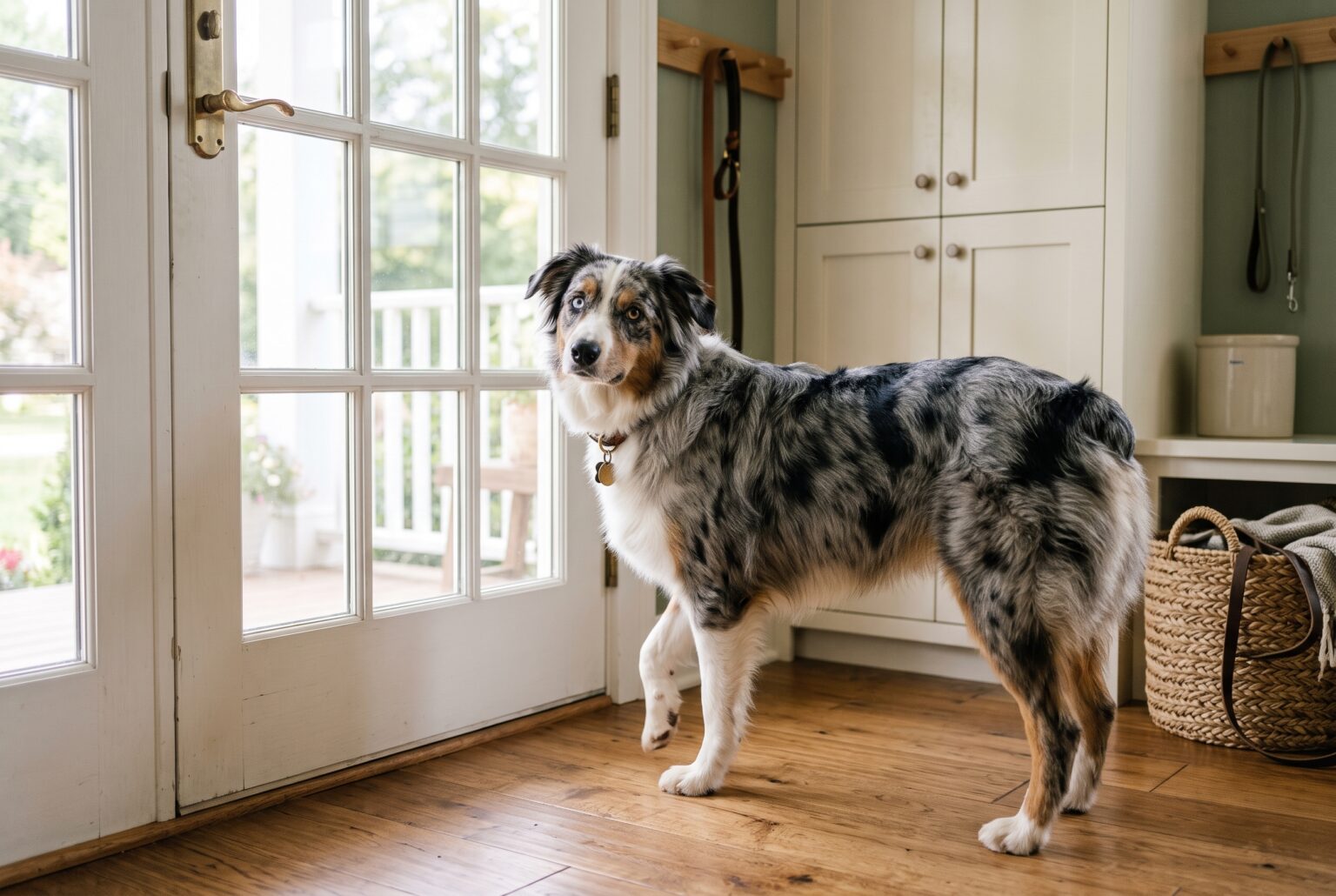
The classics are easy to spot once you know them: a sudden burst of floor-sniffing, circling a spot, restless pacing, whining, an abrupt stop in the middle of play, or simply walking to the door and looking back at you. The ASPCA describes the pre-potty routine as sniffing, circling, and walking with stiff back legs, all of which mean you should get your dog to her spot right away.
No dog does all of these, and that is the catch. Each dog has her own short routine, and big dogs in particular can be quick and quiet about it. The accident in a house full of people who adore the dog almost always comes down to one missed signal.
The tells worth watching for
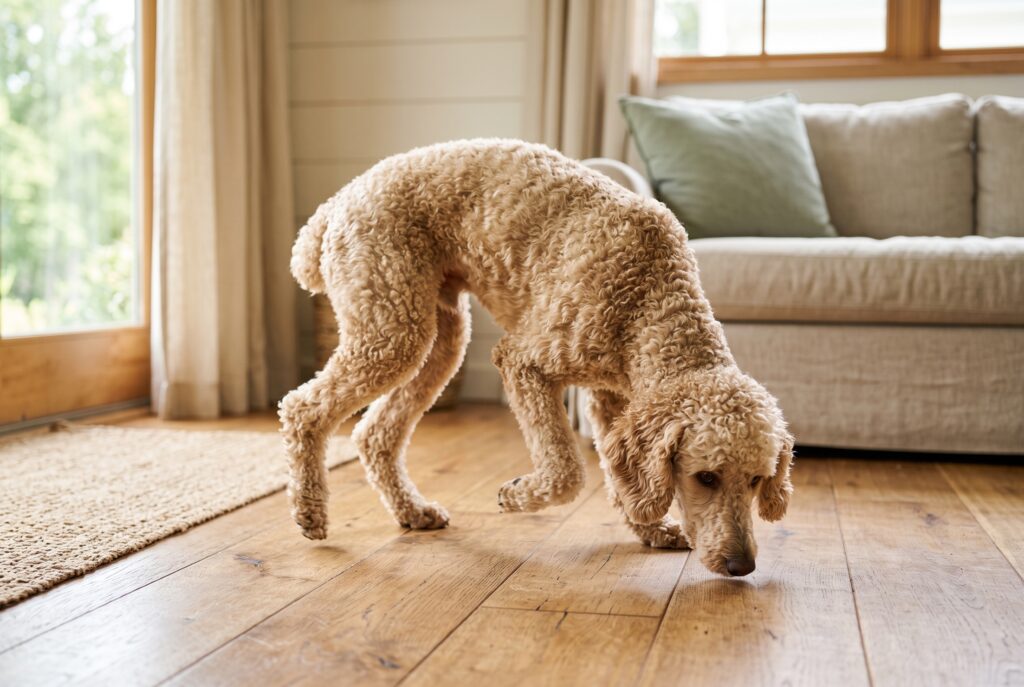
Learn your dog’s personal routine and you can beat the accident to the door. The signals to watch for:
- Sniffing and circling. The hardwired search for the right spot. If you see it indoors, the clock is already running.
- Sudden restlessness or pacing. A dog who was settled and is now wandering the room is often looking for an exit.
- Heading for the door. The clearest natural tell. Reward it every single time so it sticks.
- Whining, pawing, or staring at you. Your dog asking the only way she knows how. Answer it fast and you teach her it works.
- Stopping mid-play. An abrupt freeze in the middle of a game is a classic I-need-to-go signal, especially in puppies.
One tell you can file under fun trivia: dogs tend to line their bodies up along the north-south axis when they relieve themselves, at least when the Earth’s magnetic field is calm. It is a real, peer-reviewed finding, but it explains how a dog orients, not why she circles, and it will not help you read a thing. We dug into the spin in why dogs spin before they go.
Why big and giant breeds are the easiest to miss
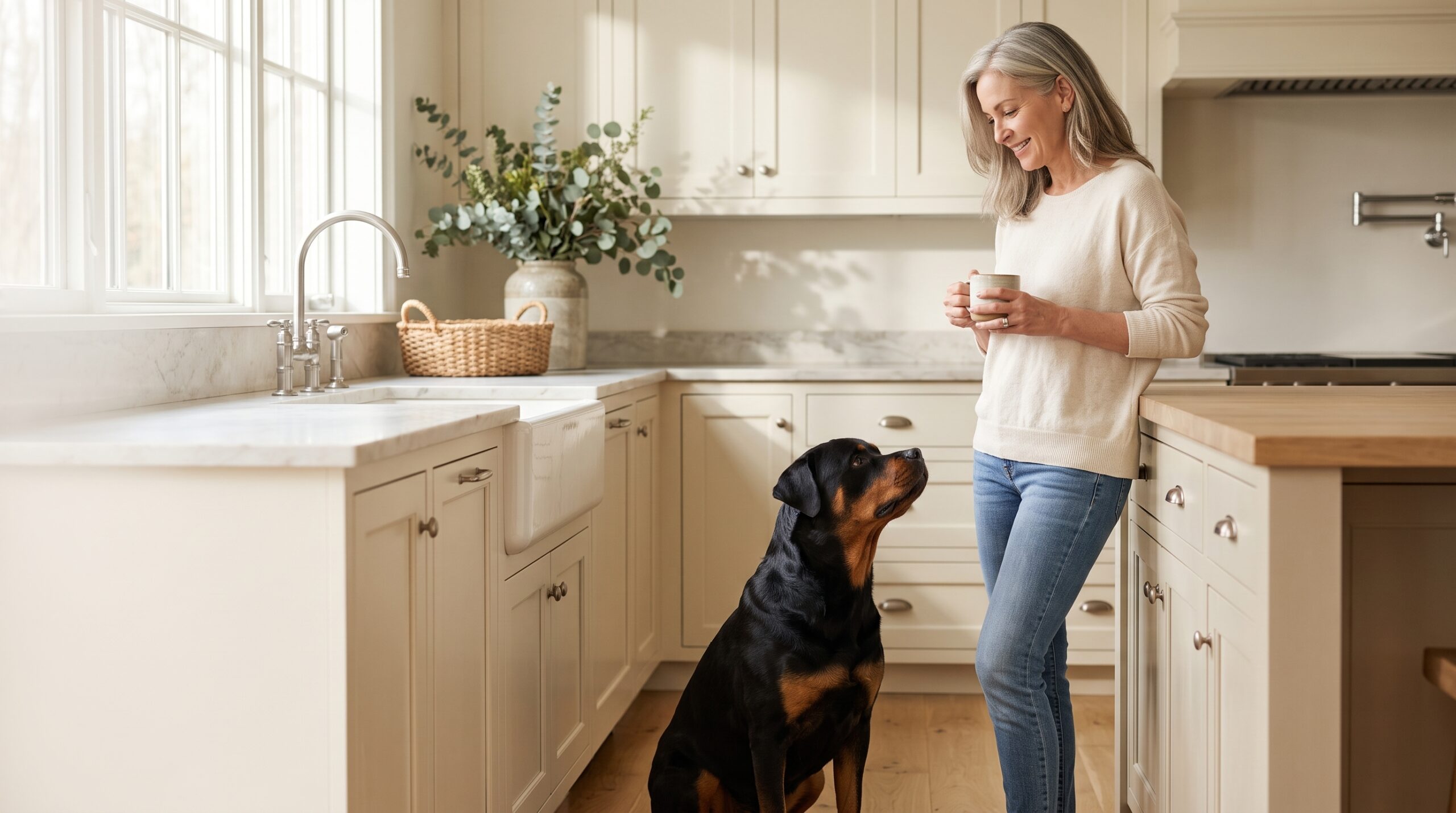
You would think a hundred-pound dog would be impossible to overlook. The opposite is often true. A big dog’s signals can be understated, a single slow circle, one quiet look toward the hall, and the window between the signal and the squat can be short. Add a busy household and the tell slips right past everyone.
There is also a simple matter of plumbing, and two numbers people constantly confuse.
A big dog holds more, and warns you for less time
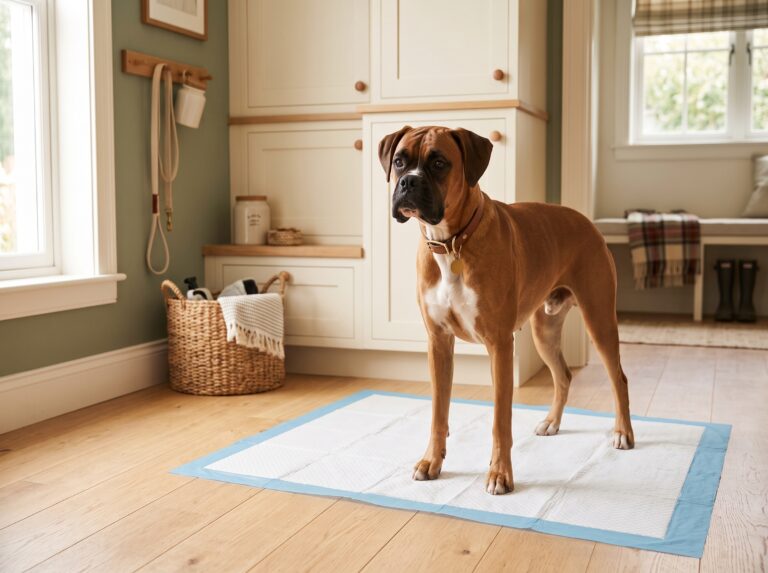
The first number is how much a bladder holds in one trip. For a 150-pound dog that runs from roughly 3 cups up to about 5 and a half cups when full. The second, completely separate number is how much a dog makes in a whole day: about 4 to 8 cups for a large breed. (A real jump in how much, or how often, your dog goes is worth a vet visit. It can point to a urinary tract infection, diabetes, kidney disease, or other issues, all covered further down.) For reading signals, the lesson is simple. A giant breed carries a big load, so when the urge hits it can hit hard and fast. Miss the tell and you are not blotting a small spot, you are mopping a flood. That is also the honest case for a properly sized pad: if it is going to happen, give it somewhere to land. Find your dog’s size here.
"The accident usually was not the dog ignoring you. It was the one quiet signal she gave, slipping past a busy room."
Teach your dog a signal you cannot miss
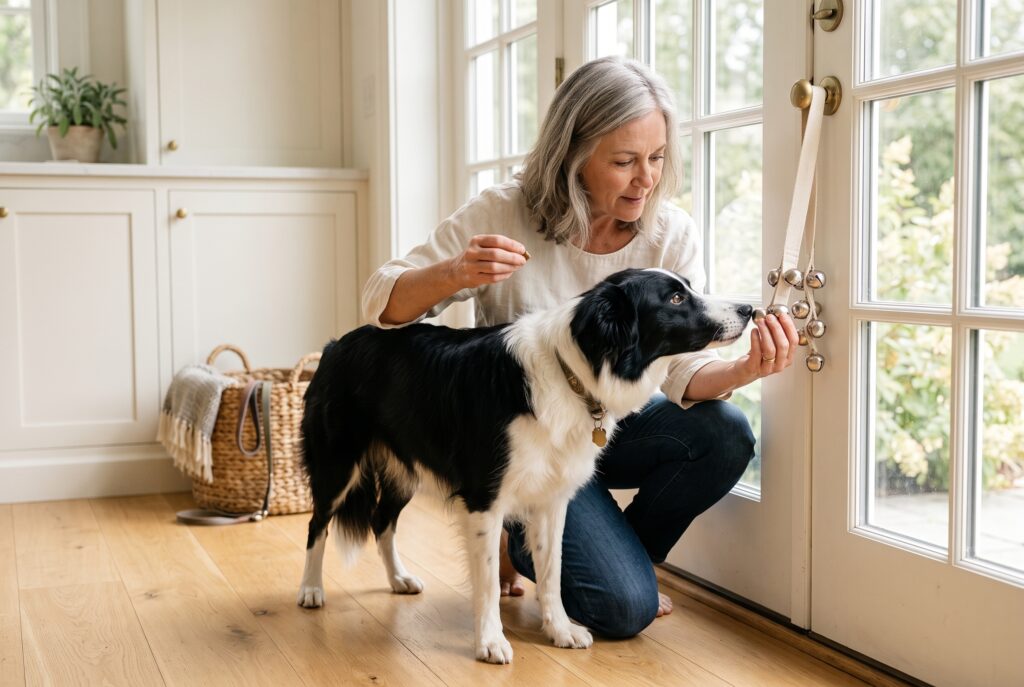
Reading your dog’s natural tells is half the job. The other half is giving her a deliberate way to ask, one you will catch from across the house. Two methods work well.
The bell at the door
The bell is built on a simple nose touch. Teach your dog to bump a target with her nose for a reward (the AKC has a good nose-target walkthrough), hang a bell at the door, and ring it every single time you head out. Reward only after she actually goes outside, then slowly fade your own prompt. Give it a couple of weeks of consistency before she reliably connects bell to bathroom. One caution: introduce it too loosely and some dogs decide the bell is a fun toy. Kikopup has a careful bell-training video worth watching first.
The no-bell ask
Prefer no hardware on the door? You can capture your dog’s natural move toward the door and reward it until it becomes a clear, deliberate ask. McCann Dogs has a clean walkthrough of teaching a dog to ask to go out without a bell.
What about the talking buttons?
You have seen the videos: dogs pressing soundboard buttons for outside, walk, potty. Here is the honest state of it. A 2024 study from the University of California San Diego analyzed 152 dogs and more than 260,000 button presses and found that dogs press buttons in non-random, non-accidental ways, including two-button combinations. That is genuinely interesting work. But the researchers are careful, and so are we: this is emerging science about symbolic communication and its limits, not proof that dogs are talking in the way people do. If you enjoy it, a potty button can be one more way your dog asks. Just do not expect it to replace plain old signal-reading.
How often does your dog need a trip?
- 8 weeks
- Constantly, every 1 to 2 hours, with almost no warning. Run on a schedule; do not wait for a signal yet.
- 3 months
- Every 3 to 4 hours (Humane World: about one hour per month of age; AKC: age in months plus one). Tells start becoming readable.
- 4 to 5 months
- Every 4 to 5 hours. Real bladder control is still forming; most puppies firm up somewhere between 12 and 16 weeks.
- Healthy adult
- Should get outside at least 3 to 5 times a day (Humane World). She can hold it for hours, but all day is not the goal.
- Senior
- Often needs more frequent trips again. New accidents in an older dog are a reason to call the vet, not to start over on training.
When a signal is really a health flag
This is the most important rule in the whole article: when a dog who was reliable suddenly starts having accidents, treat it as a medical question first, not a training one. A dog producing more urine than her bladder can hold will break house training no matter how well taught she is, and no amount of practice fixes a physical cause.
Increased thirst and urination together (vets call it PU/PD) is a classic hallmark of several conditions, most commonly chronic kidney disease, diabetes, and Cushing’s. In senior dogs, house-soiling can also be an early sign of cognitive decline; veterinarians screen for it with a framework called DISHAA (disorientation, interactions, sleep-wake cycle, house-soiling, activity, anxiety). The ASPCA describes the same thing for owners in plainer language as CRASH. Either way, the message is identical: a sudden change in an older dog’s habits is worth a conversation with your vet.
This article is general information, not veterinary advice. If your dog’s bathroom habits change suddenly, please see your veterinarian. The conditions below are described to help you know when to call, not to diagnose at home.
Sudden accidents: what a vet rules out
- Urinary tract infection
- Frequent small voids, straining, blood, or licking. Common and very treatable.
- Diabetes mellitus
- A lot of water in and a lot of urine out, big appetite paired with weight loss.
- Cushing’s disease
- Increased thirst and urination in 80 to 90 percent of cases, plus pot belly, panting, and hair loss (Cornell, Merck).
- Bladder stones
- Straining, painful urination, blood, and repeat infections.
- Kidney disease
- Increased drinking and urination as the kidneys lose their ability to concentrate urine.
- Cognitive decline
- In seniors: disorientation, sleep changes, and house-soiling. Vets screen with DISHAA (VCA, AAHA).
The mistakes that cause accidents
A few habits quietly undo all your signal-reading. Drop these:
- Believing she did it out of spite. Dogs do not do revenge. An accident is a physical need or a distress response, never payback. The ASPCA is explicit about this.
- Punishing after the fact. She cannot connect a scolding to something she did minutes ago. Rubbing her nose in it only teaches her to fear you and hide the next one. The ASPCA, the AVSAB, and the AKC all agree, and the AVSAB calls nose-rubbing no longer safe or effective.
- Expecting her to hold it all day. An adult should get out three to five times a day. Morning to night with no break is not a fair ask, and it ends in an accident that is on the schedule, not the dog.
- Rushing the bell. The bell only works if you build it on a nose touch and reward after she goes outside. Hang it and hope, and you just gave her a toy.
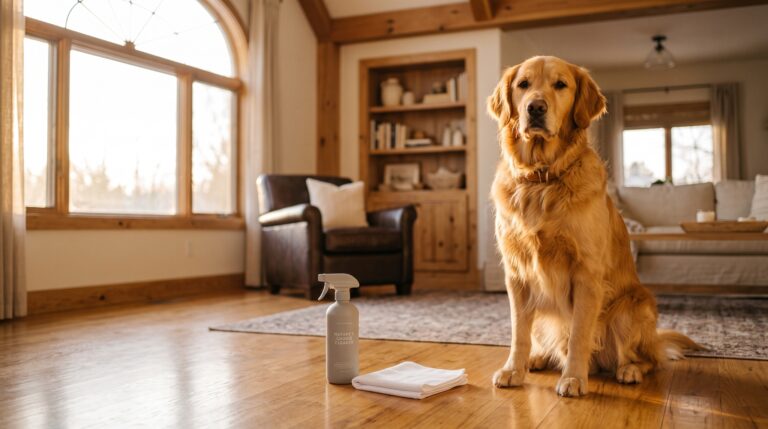
- Treating a sudden change as defiance. In a previously reliable dog, accidents are medical until proven otherwise. Clean every spot with an enzymatic cleaner so old odor does not invite a repeat, then call your vet.
The honest bottom line
Your dog is communicating about this all day long. Learn her quiet tells, the sniff, the circle, the look at the door, and answer them fast. Give her one deliberate signal she can use, whether that is a bell or a trained ask at the door. Match the schedule to her age, not your convenience. And the moment a reliable dog changes her pattern, think vet before you think training.
Do that and the guesswork mostly ends. She tells you, you listen, and the floor stays dry. For more on the setup side of things, see how to train a big dog to use a pee pad, and if you want the right pad under her for the times you miss the signal, find your dog’s size or browse the XL, XXL, and XXXL Farmhouse pads built for big and giant dogs.