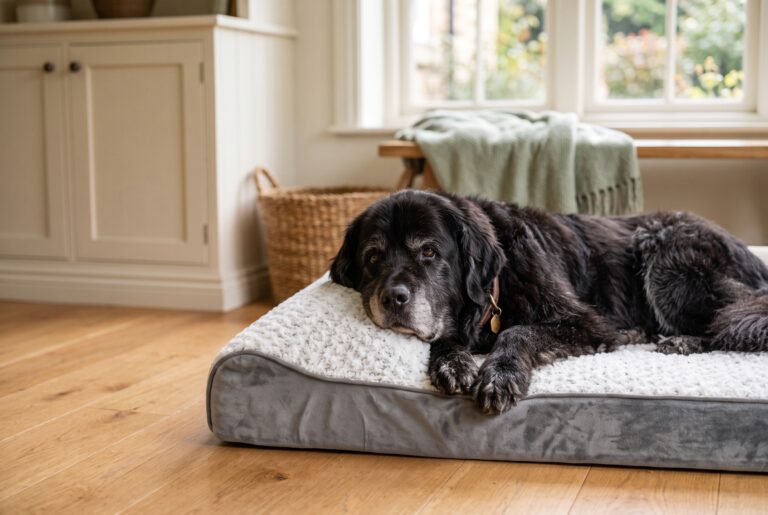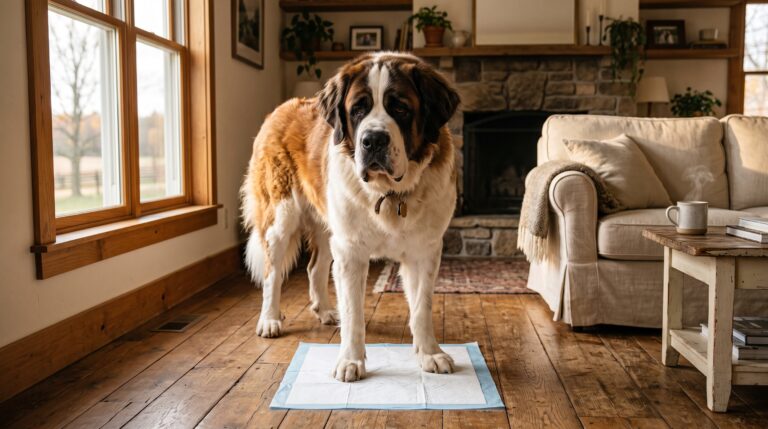
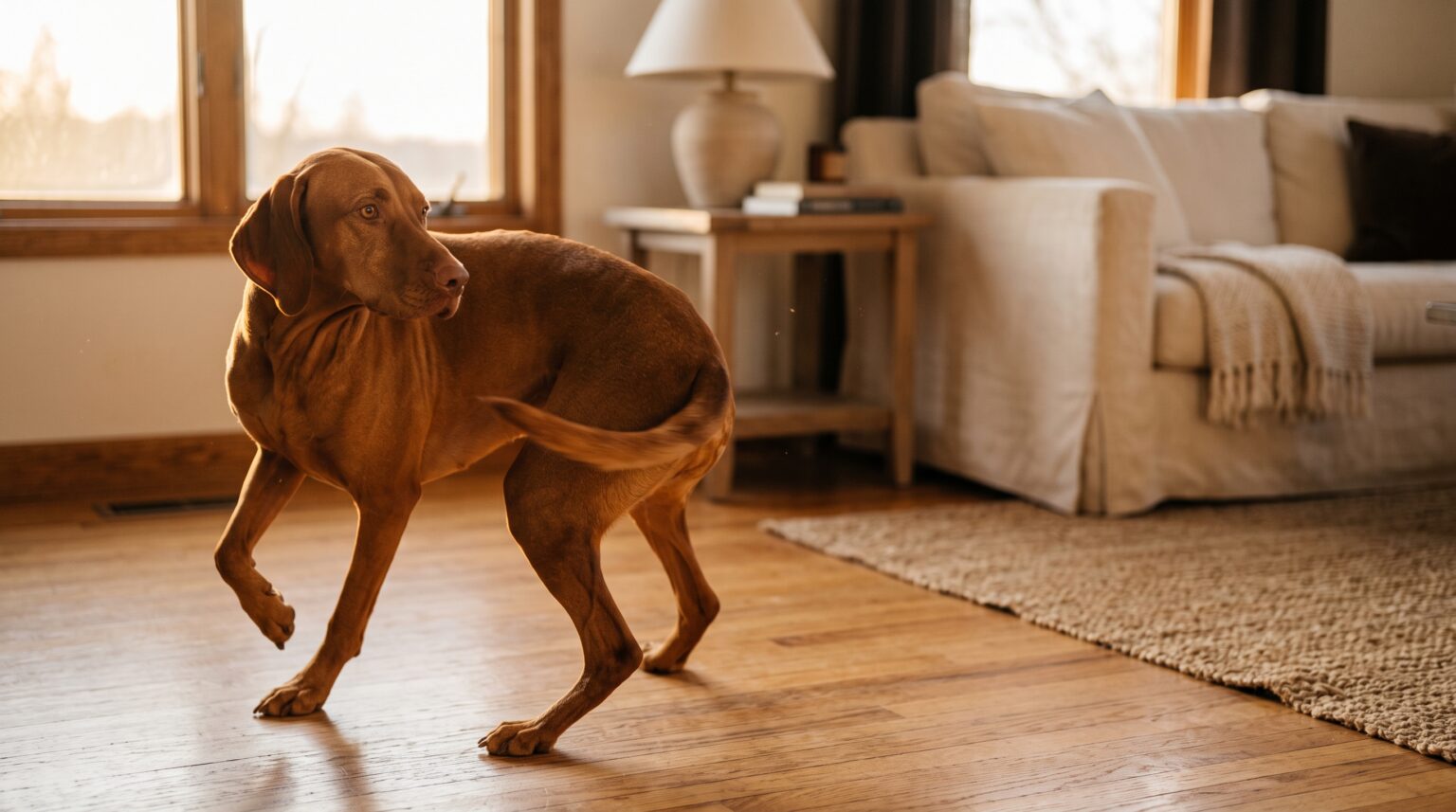
If you’ve ever watched your dog get ready to go, you know the routine: nose down, a few tight circles, and only then do they settle in to do their business. It looks like a harmless quirk. It isn’t. That little spin is a hardwired instinct passed down from your dog’s wild ancestors, and once you understand it, one of the most frustrating problems in indoor potty training finally makes sense: why big dogs always seem to miss the pad.
Here’s what’s really going on, and how to use it to pick a pad that actually works for your dog.
New here? This article is part of our complete guide to big-dog potty training.
The Three Reasons Dogs Circle Before They Go
It looks like a quirk. It's actually a survival routine, three instincts, refined over thousands of years, still running on your living-room floor.
1. A quick safety check. Going to the bathroom leaves a dog briefly vulnerable. In the wild, squatting without scanning your surroundings was a genuine risk. Turning a full circle lets your dog take in everything around them before they let their guard down, a built-in threat check that animal behaviorists point to as one of the main reasons for the spin.
2. Clearing the ground. Long before hardwood floors and living rooms, dogs did their business in tall grass and brush. The circling motion worked like a lawnmower: it trampled the area flat and drove off any insects hiding where they were about to settle.
3. Lining up with the Earth’s magnetic field. This is the one that surprises people. In a two-year study published in the journal Frontiers in Zoology, researchers tracked 70 dogs across 37 breeds and found that, when the Earth’s magnetic field was calm, the dogs consistently preferred to line their bodies up along the North-South axis to relieve themselves. The catch is that the magnetic field is only calm about a fifth of the daylight hours, and when it’s unsettled, the pattern disappears. So your dog isn’t doing it every single time. But on a quiet day, that little spin may genuinely be your dog finding North. It’s a strange, wonderful fact about the animal asleep on your couch.
Why This Trips Up Big Dogs Indoors
Now connect all that instinct to the pad on your floor.
When your dog steps onto a pad, the urge to circle doesn’t switch off just because they’re inside. But a big dog has a big turning radius. As they spin to scan the area and settle in, their back legs swing wide, and on an undersized pad, those legs land on your floor instead of the pad. By the time the ritual is done, half the dog is hanging over the edge.
It isn’t bad aim, and it isn’t a training failure. The pad was simply too small for the dog’s natural movement, and the dog was always going to follow its instincts. The fix isn’t more training. It’s more pad.
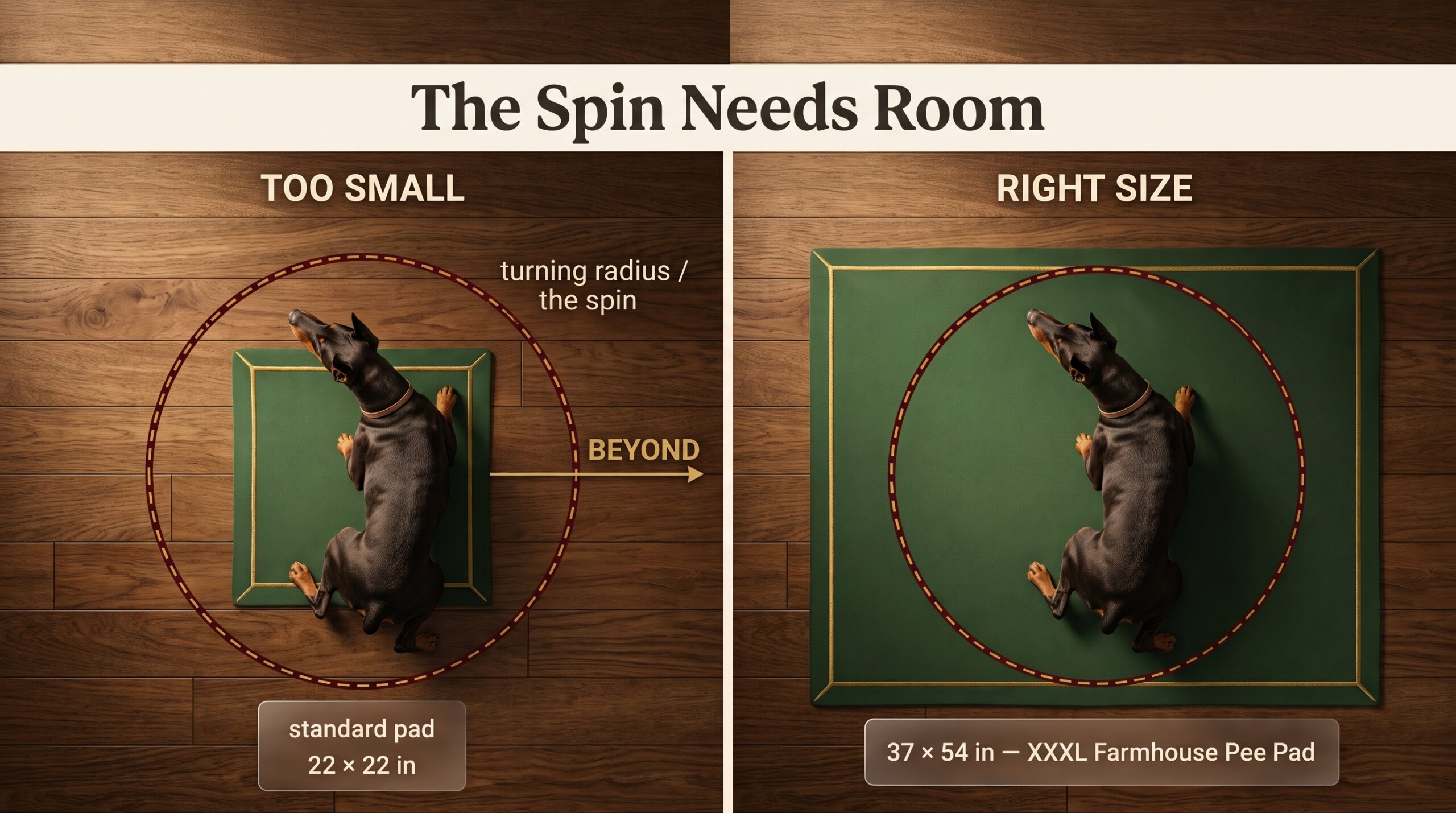
"No one has ever called us wishing they'd sized down. When a big dog misses, the answer isn't more training. It's more pad."
How to Choose the Right Size
The simplest way to size a pad is to find your dog’s breed and weight on the guide below, then follow one rule above everything else: when your dog falls between two sizes, go up. A pad that’s a little too big costs you nothing. A pad that’s a little too small ends up on your floor.
A good gut-check: your dog should be able to turn a complete circle without a single paw leaving the pad. If you can picture your dog spinning comfortably with room to spare, you’ve got the right size.
The Honest Size Guide
We make three sizes, all built for medium, large, and giant dogs. We’ll also tell you straight when one of our pads is more than you need.
22 × 22 in · Small & Toy Breeds (we don’t make this one, and here’s why)
If you have a Chihuahua, a Yorkie, a Pomeranian, a Toy Poodle, a Miniature Dachshund, or a small-breed puppy in the early weeks of training, a standard 22×22 pad is genuinely all you need. These dogs have a tiny turning radius and won’t come anywhere near the edge.
We don’t make a pad this small, because small dogs aren’t who we built Farmhouse for. There are plenty of good 22×22 pads out there. Buy one and don’t overspend. We’d rather tell you that honestly than sell you something you don’t need. And when that puppy grows into a bigger dog and starts stepping off the little square, you’ll know exactly where to find us.
One exception worth a judgment call. If you’ve got a large, rambunctious puppy who’s already barreling off the edges, or you’re lining a whelping box for a new litter, a 22×22 usually won’t cut it. That’s the one time we’d point you toward one of our bigger pads instead. Our 36×36 is a favorite for whelping boxes, with the room for mom and the litter and the heavy-duty absorbency a new litter demands.
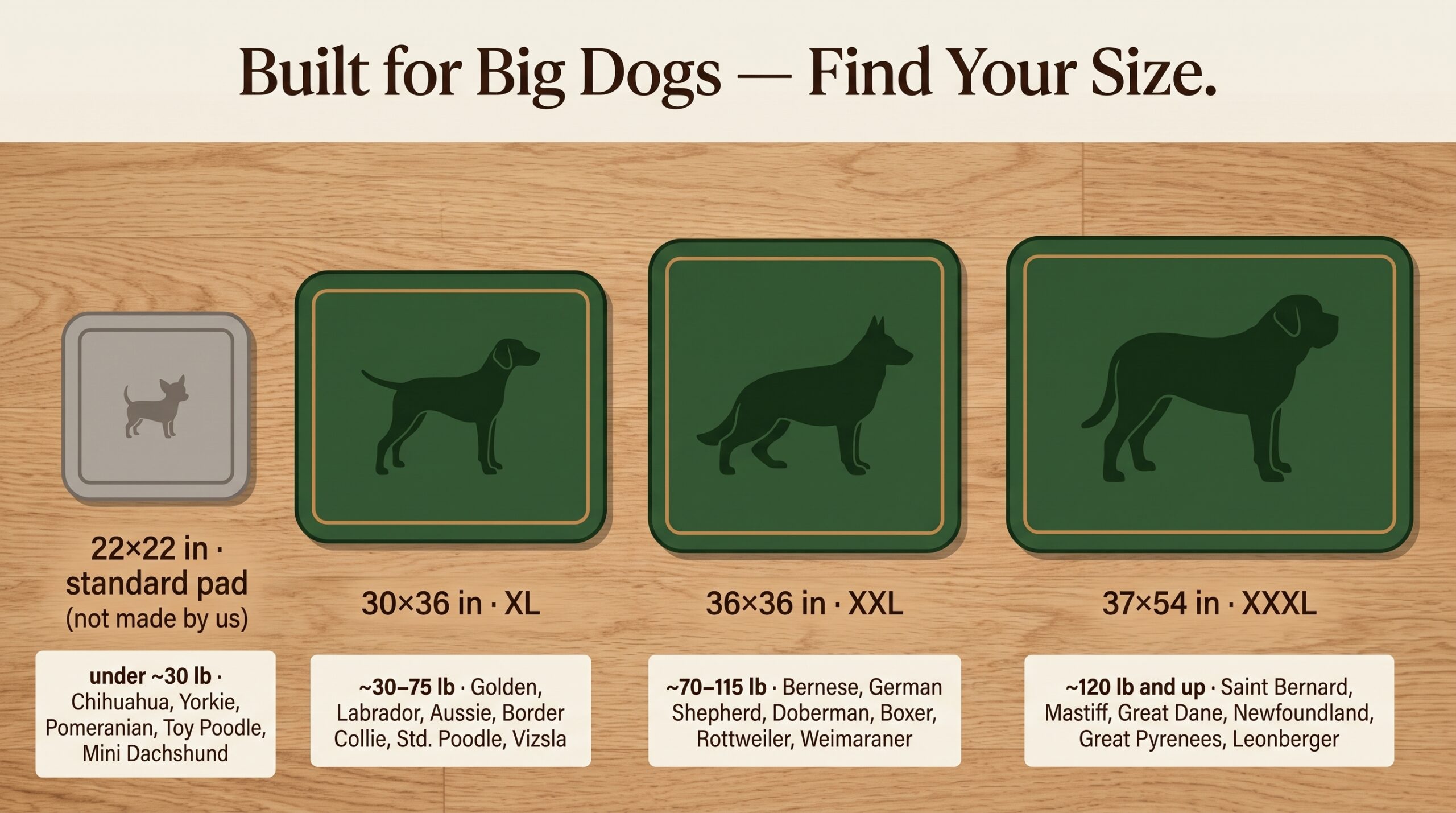
30 × 36 in · The XL Farmhouse Pee Pad · The Large-Breed Baseline
Best for: Golden Retrievers, Labradors, Australian Shepherds, Border Collies, Standard Poodles, Vizslas, Flat-Coated Retrievers, Brittanys (roughly 30–75 lb).
A Golden or a Lab is simply too long to pivot on a small square and ends up stepping off mid-spin. The rectangular 30×36 footprint gives a medium-to-large breed the room to complete its turn without backing its hind legs over the edge. If you’ve got a classic family large-breed dog, this is your starting point. See the XL Farmhouse Pee Pad →
36 × 36 in · The XXL Farmhouse Pee Pad · For Big, Broad, and Heavy Dogs
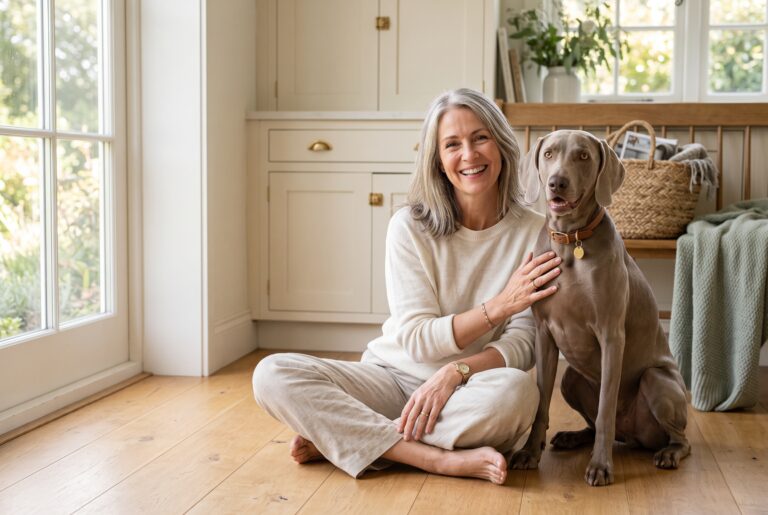
Best for: Bernese Mountain Dogs, German Shepherds, Dobermans, Boxers, Rottweilers, Weimaraners, Rhodesian Ridgebacks (roughly 70–115 lb).
These dogs are heavier, taller, or broader through the chest than a Lab, simply more dog to turn around, and often more deliberate about their circling. A true 36-inch square gives an equal turning radius in every direction, so no matter which way your dog lines up, they’ve got three full feet of heavy-duty space to spin, settle, and stay on the pad. See the XXL Farmhouse Pee Pad →
37 × 54 in · The XXXL Farmhouse Pee Pad · Built for Giants
Best for: Saint Bernards, Mastiffs, Great Danes, Newfoundlands, Great Pyrenees, Leonbergers, Irish Wolfhounds, Cane Corsos (roughly 120 lb and up).
This is the size the pet industry forgot, the point where big-box pads quit working altogether. Put a Saint Bernard or a Mastiff on an ordinary pad and half the dog is on the floor before the spin is even finished. At a full 37×54, even the largest breeds get the runway their size demands. It’s also the size we steer multi-dog households toward, and any owner who’d simply rather have room to spare. The floor stays clean, and the dog stays comfortable. See the XXXL Farmhouse Pee Pad →
Quick Reference: Find Your Dog
| Example breeds | Typical weight* | Pad size | Farmhouse product |
|---|---|---|---|
| Chihuahua, Yorkie, Pomeranian, Toy Poodle, Mini Dachshund | under ~30 lb | 22 × 22 in | Not made by us, buy any standard pad |
| Golden Retriever, Labrador, Australian Shepherd, Border Collie, Standard Poodle, Vizsla | ~30–75 lb | 30 × 36 in | XL Farmhouse Pee Pad |
| Bernese Mountain Dog, German Shepherd, Doberman, Boxer, Rottweiler, Weimaraner | ~70–115 lb | 36 × 36 in | XXL Farmhouse Pee Pad |
| Saint Bernard, Mastiff, Great Dane, Newfoundland, Great Pyrenees, Leonberger | ~120 lb and up | 37 × 54 in | XXXL Farmhouse Pee Pad |
*Weight is a guide, not a hard rule. A tall, long, or broad dog needs more turning room than the number on the scale suggests. Between two sizes? Go up.
Give Your Dog the Room They Need
You can’t train the instinct out of a dog, so the pad has to work with it, not against it. We started Farmhouse because the pet aisle treats big dogs like an afterthought, and a dog that can’t comfortably turn around on its pad isn’t being stubborn; it’s being asked to do the impossible.
Match your dog to the right size, give them room to spin, and the floor next to the pad stays dry.